Table of Contents
ToggleA Japanese bedroom isn’t about austere emptiness, it’s about intention. Every piece serves a purpose: every surface breathes. This design philosophy, rooted in Zen principles and centuries of Japanese minimalism, creates spaces that feel restful without feeling cold. Whether you’re renovating a master suite or refreshing a guest room, incorporating Japanese bedroom ideas means thinking beyond Pinterest aesthetics and understanding the materials, proportions, and spatial flow that make these rooms genuinely calming. This guide walks you through seven practical approaches to bring that serene energy into your own bedroom, with concrete steps you can tackle yourself or plan with a contractor.
Key Takeaways
- Japanese bedroom ideas prioritize intentional design and minimalism, where every piece serves a purpose and visual clutter is eliminated to create genuinely restful spaces rather than sterile ones.
- Natural materials like raw wood, stone, linen, and paper are essential to Japanese bedroom design, as they age gracefully and should be paired with warm neutral tones such as soft greiges and off-whites.
- Low-profile beds (12–18 inches off the ground) and integrated storage solutions like wall-mounted shelving and under-bed drawers reduce visual bulk while maintaining the minimal aesthetic.
- Layered, warm-toned lighting (2700K color temperature) positioned low throughout the room—using bedside lamps, wall sconces, and diffused fixtures—creates calm ambiance without overhead ceiling lights.
- Traditional tatami mat flooring or solid wood with natural finishes provides authentic sensory grounding, though professional installation is recommended for proper subfloor preparation and moisture barriers.
Embrace Minimalism and Clean Lines
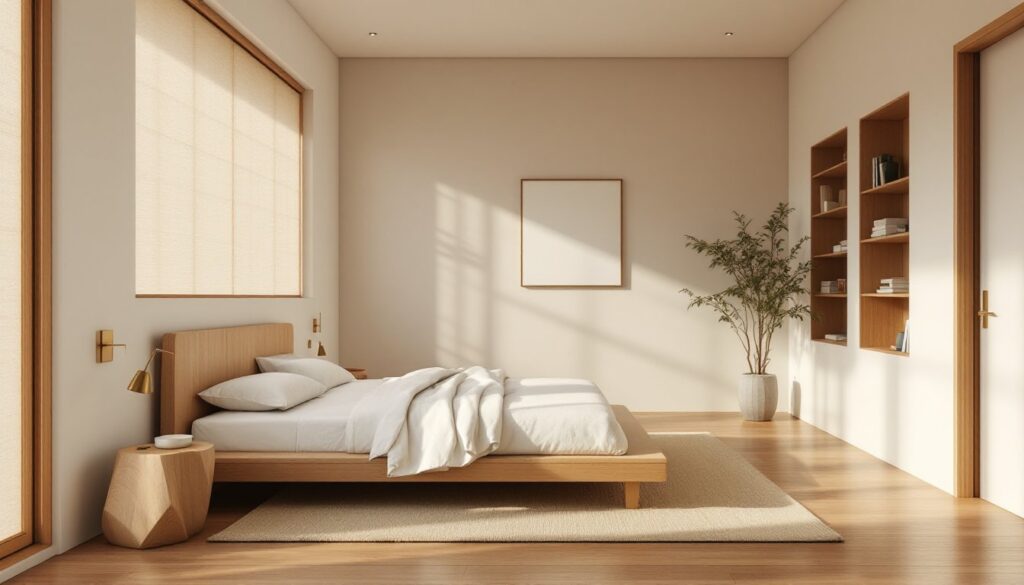
Japanese bedroom design starts with subtraction, not addition. Before you buy anything, look at what you actually use. Your nightstands should hold a lamp and maybe a book, not a phone charger, three candles, and last month’s magazines. Clean lines mean straightforward furniture with minimal ornamentation: a bed frame with simple geometric proportions, shelving without decorative corbels or crown molding, walls without baseboards (or thin, inconspicuous ones).
This doesn’t mean your room feels sterile. Instead, the lack of visual clutter lets your eye rest and your mind settle. A single piece of art on a wall becomes meaningful rather than competing with five other pieces. One sculptural wooden side table, beautifully finished, reads louder than a nightstand covered in trinkets.
When planning your layout, avoid floating furniture in the middle of the room. Position the bed against a wall (traditionally the wall opposite the entry, for a sense of stability). Keep pathways clear and wide enough to move through without stepping over items. This spatial simplicity is what makes Japanese bedrooms feel bigger than their square footage.
Choose Natural Materials and Earthy Tones
Japanese interiors lean on materials that age gracefully: raw wood, stone, clay, linen, and paper. These aren’t just aesthetic choices, they’re functional and durable. A solid wood bed frame in natural oak or ash will outlast particle-board furniture by decades, and it looks better as it patinas.
For walls, consider warm neutrals: soft greiges, warm whites, and muted taupes. Skip pure white unless you’re going for an extremely modern interpretation. Japanese interiors typically use off-whites with slight warmth, imagine the color of parchment or sand. If you want accent color, think nature: deep forest green, soft charcoal, or muted clay. These anchor a room without overwhelming it.
Sources like Homedit showcase how natural materials form the backbone of cohesive design schemes. For flooring and wall treatments, research finishes that feel authentic: unsealed or lightly finished wood rather than high-gloss polyurethane, and walls with subtle texture rather than slick paint. Avoid vinyl or laminate that mimics wood: real materials have presence that fakes simply don’t. If budget limits your choices, invest in high-quality finishes for surfaces you touch daily, flooring, bed frame, and bedside tables.
Incorporate Traditional Japanese Flooring
Tatami mats, woven straw mats about 1.5 inches thick, are the traditional foundation of a Japanese bedroom. They’re warm underfoot, naturally insulating, and carry a subtle grass scent. A full tatami floor requires proper subfloor preparation and precise measurements, since tatami comes in standard sizes (a single mat is roughly 3 feet by 6 feet, though dimensions vary regionally). Laying tatami is a specialized skill: unless you’ve worked with them, hire a professional familiar with Japanese flooring.
For a more accessible starting point, consider a tatami mat runner (a 2-by-6-foot strip) placed beside the bed or in the main pathway. This gives you the sensory and aesthetic benefit without a full floor commitment. Alternatively, install solid wood flooring with a natural finish, white oak or ash, and add a smaller jute or hemp rug for texture and warmth.
If you’re installing any new flooring, allow materials to acclimate to your room’s humidity for at least 48 hours before installation. Wood flooring especially expands and contracts with moisture. In high-humidity climates, underfloor moisture barriers become essential to prevent warping. Check local building codes for moisture and ventilation requirements in bedrooms: they vary by region but typically mandate adequate underfloor ventilation, especially over crawl spaces.
Add Authentic Furniture and Storage Solutions
Low-Profile Beds and Futons
A low platform bed, typically 12 to 18 inches off the ground, is iconic in Japanese bedrooms. This design reduces visual bulk and creates a sense of groundedness. You can purchase a Japanese-style platform bed (look for solid wood construction without a footboard) or build one with 2×8 or 2×10 lumber for the frame and a simple plywood base topped with a quality mattress.
Futons are also an option if you have the space to store or fold them during the day. A genuine futon (not a cheap convertible sofa) uses layered cotton and natural fibers, typically 3 to 6 inches thick. They’re firmer than Western mattresses but provide good support when placed on a low platform. The futon can be rolled or folded away during the day, freeing floor space and maintaining that minimal aesthetic.
When building or buying a platform, use solid wood or quality plywood, never particleboard. Ensure the structure can support your weight plus a mattress safely, aim for joints that are mortised or heavily braced, not just butt-jointed. Sand and finish wood with food-safe oil or matte polyurethane to enhance the grain without creating gloss.
Integrated Storage and Shelving
Cluttered closets breed cluttered rooms. Japanese bedrooms typically hide storage in a few key places: shallow built-in shelving, recessed wall niches, or under-bed drawers. Rather than a decorative dresser taking up floor space, consider wall-mounted shelving at consistent heights, or have a carpenter install a shallow closet system with pull-out drawers.
If adding shelving, use solid wood shelves (1 inch thick for shelves under 36 inches wide) supported by L-brackets rated for the load. Avoid glass shelves unless you’re displaying specific items: they read cold. Keep shelves 75% full, that remaining 25% is breathing room for the eye.
For clothing, fold rather than hang where possible: hanging clothes take up vertical space and create visual noise. MyDomaine’s interior design tips emphasize how storage that’s out of sight is foundational to a calm aesthetic. Under-bed storage boxes (low-profile, wooden) can hold seasonal items or extra linens. Label everything so you use what you store.
Layer Lighting for Calm Ambiance
Japanese bedrooms avoid overhead ceiling lights. Instead, layer soft, warm sources positioned low: a bedside reading lamp (ideally with an adjustable arm or shade that directs light down), wall-mounted sconces at eye level, and perhaps a low-wattage floor lamp in a corner. Aim for 2700K color temperature (warm white) rather than cool 4000K or 5000K bulbs, which feel sterile.
Consider rice-paper or fabric shades that diffuse light rather than emit it in sharp beams. These create a soft, enveloping glow. Avoid chrome or polished metal fixtures: matte brass, iron, or wood finishes feel more aligned with Japanese aesthetics.
Wall-mounted sconces flanking the bed are both functional and elegant, they free nightstand space and light your face evenly for reading. When installing sconces, position the center of the shade 48 to 60 inches from the floor (about eye level when sitting) and ensure they’re 12 to 18 inches from the edge of the mattress. Consult local electrical codes: in most jurisdictions, bedroom lighting circuits are on a 15-amp breaker shared with receptacles, so plan your wiring accordingly, or hire a licensed electrician.
Adding a dimmer switch to bedroom circuits gives you flexibility for different moods, full light for cleaning or dressing, dimmed for unwinding. Dimmers are simple to install if you have existing switch boxes: just turn off the breaker, remove the old switch, and wire in the new dimmer according to the manufacturer’s instructions. If you’re not comfortable with electrical work, a licensed electrician can do it in under an hour.
Research from House Beautiful’s Japanese bedroom collection highlights how subtle, layered lighting transforms perceived spaciousness and comfort. Avoid string lights, neon, or anything trendy: choose fixtures that will feel appropriate five years from now.