Table of Contents
ToggleA small kitchen doesn’t have to feel cramped or limiting, it’s an opportunity to design smarter. Whether you’re tackling a small kitchen remodel, exploring small kitchen design ideas, or working with very small kitchen ideas on a budget, the key is making every square inch count. With thoughtful planning and strategic choices, homeowners can turn tight layouts into highly functional spaces that cook as efficiently as much larger kitchens. This guide walks you through proven small kitchen layout ideas, storage solutions, and design tactics that work in real homes, no Instagram fantasy required.
Key Takeaways
- Vertical storage—floating shelves, wall-mounted strips, and ceiling-height cabinets—maximizes function in a small kitchen by pulling items off countertops and utilizing overhead space.
- Rolling carts and slim islands (18–24 inches deep) add flexible workspace and storage without consuming floor space like fixed islands do.
- Light, neutral wall colors combined with strategic accent hues on cabinets or open shelves prevent small kitchens from feeling bland while maintaining an airy, spacious feel.
- Layered lighting (ambient overhead, task under-cabinet LEDs, and accent pendant lights) is essential to eliminate shadows and make tight spaces feel larger and safer.
- The work triangle (sink, stove, refrigerator) should span 4–9 feet in small kitchens, and door swings matter—confirm appliance hinge directions before remodeling.
- Right-sizing appliances—30-inch refrigerators, two-burner cooktops, and 24-inch single-basin sinks—reclaims precious square footage while maintaining full functionality.
Maximize Counter Space With Smart Storage Solutions
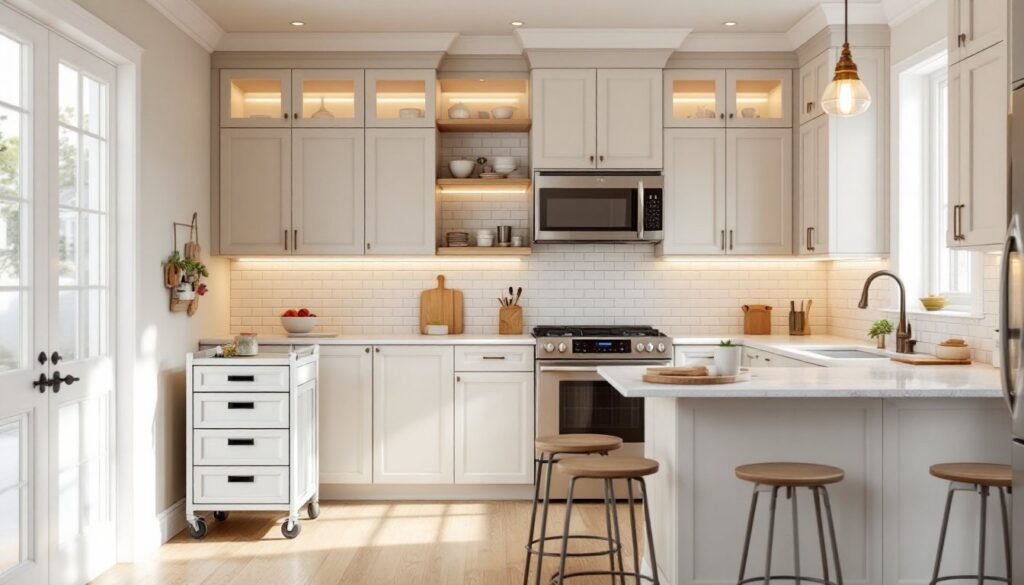
Counter clutter kills functionality in a small kitchen. The goal is vertical storage: pull items off the countertop and stack them upward. This is where small kitchen cabinet ideas shine, corner cabinets with pull-out shelves, pegboards for utensils, and wall-mounted magnetic strips for knives all reclaim precious surface area.
Vertical Storage Strategies
Install floating shelves above counter areas to hold glasses, bowls, and cooking gear. Use the space above the sink for a narrow shelf running the cabinet length, even 8 inches deep works. Stack pots on pegboards or magnetic rails rather than in deep cabinets where they’re hard to access. Pull-out pantry cabinets fit into awkward gaps (like the slim space between the refrigerator and wall) and slide out when needed, then tuck away. Open shelving shows what you have, so be selective: store only daily-use items here.
If your layout allows, install cabinets that reach the ceiling. Most ceilings are 8–9 feet: standard wall cabinets are 30–36 inches tall, leaving 30+ inches of dead space overhead. Add a row of smaller cabinets (12 inches tall) up high for serving dishes and seasonal items. Ladder shelving (leaning shelves that look minimal) works in corners and adds vertical interest without the weight commitment of permanent shelving.
Multi-Functional Kitchen Islands and Carts
A fixed island eats floor space in a truly tiny kitchen, but a narrow, rolling cart doesn’t. Look for a cart 24–30 inches wide with drawers, shelves, and a countertop. Roll it next to the stove for prep space, then tuck it into a corner as a mobile pantry or beverage station. This is one of the smartest small kitchen remodel ideas because it works for renters too, no installation required.
If you have 3+ feet of clear floor space, a slim island (18–24 inches deep) with open shelving underneath breaks up the galley feel and adds actual workspace. Pair it with tall bar stools that tuck completely under the overhang. The space below stores baking pans, mixing bowls, and bulky items that might otherwise demand cabinet real estate.
Choose the Right Color Palette to Enhance Your Space
Light, neutral colors reflect available light and make small kitchens feel airy. White, cream, soft gray, and pale greige (gray-beige) are safe bets. The mistake many DIYers make is going too timid: a single accent color, deep green cabinets, navy walls, or a matte black island, actually adds visual interest and prevents the space from feeling bland.
Keep wall color light, but don’t fear a subtle tone. Off-white can feel warmer than pure white and hides fingerprints better. If you want personality, paint the inside of open shelves a soft color (sage, dusty blue, warm taupe) to add depth without overwhelming the room. Avoid dark cabinets in very small kitchens: they absorb light and make the space feel smaller. If you love the look of dark wood or painted cabinetry, save it for a small kitchen design that includes strong overhead and task lighting to compensate.
Consider the flow between rooms. If your small kitchen opens directly into a living area, use similar wall colors to blur the boundaries and make both spaces feel larger. Backsplash tile is a chance to introduce subtle pattern, subway tile in a herringbone layout, white hex tile, or small mosaic adds visual interest without clashing. Shiny surfaces (glossy tile, polished counters) bounce light around: matte finishes feel calming but can show dust more easily.
Strategic Lighting to Make Your Kitchen Feel Larger
Poor lighting makes any kitchen feel cramped. Overhead lights alone create shadows and dead zones where you can’t see to prep food safely. Layer three types of light: ambient (ceiling fixture), task (under-cabinet lights at counter level), and accent (open shelving highlights).
Ambient lighting: A single overhead fixture in a small kitchen should be a flush-mount or semi-flush (mount close to the ceiling to save headroom). For a 9-foot ceiling and a 7×10-foot kitchen, choose a fixture with at least 800–1000 lumens to avoid a dungeon effect. Recessed lights work too, but plan placement carefully, they create shadows if clustered in the center.
Task lighting: This is where most small kitchen remodels fail. Under-cabinet LED strips (120 lumens per foot minimum) illuminate counters without glare. They’re cheap, easy to install with adhesive backing, and can be wired to a battery pack if you can’t access wiring. Install them at the front edge of the cabinet base, pointed downward at a 15–30 degree angle. This lights the work surface and makes the space feel brighter overall.
Accent lighting: A pendant light above a small island or cart creates a focal point and practical task light simultaneously. Choose 10–12 inches diameter maximum so it doesn’t dominate the space. Small kitchens benefit from, which help define zones and improve workflow without requiring layout changes.
Layout Planning for Better Workflow
The work triangle, sink, stove, refrigerator, is the core of kitchen layout. In a small kitchen, the goal is to keep this triangle tight and efficient, with 4–9 feet between each point. Too spread out, and you waste steps: too cramped, and doors and drawers conflict.
Galley kitchens (two parallel walls) work well in tight spaces because everything is within arm’s reach. The downside: only one person fits comfortably. If you’re designing a small kitchen from scratch, ensure at least 3 feet between facing cabinets for safe movement. L-shaped layouts use two adjacent walls and offer a corner for the work triangle. U-shaped layouts (three walls) maximize storage but eat floor space: reserve this for kitchens 10+ feet wide.
One-wall kitchens are forced on some apartments and small homes. Arrange appliances left to right: refrigerator, prep zone, sink, stove. This mirrors natural workflow and prevents cross-traffic. If your current layout feels awkward, sketch the footprint to scale (use 1/4 inch = 1 foot graph paper or a free tool like Remodelista’s curated small kitchen solutions) and test furniture positions before moving anything.
Door swings matter in tight spaces. An inward-opening refrigerator door can block the sink in a narrow galley. Some appliances come in left-hinge or right-hinge models, confirm which clears adjacent cabinets. If a remodel is in the budget, consider a slide-out or pocket door for the kitchen entrance to save swing space.
Space-Saving Appliances and Fixtures
Right-sizing appliances is non-negotiable in small kitchens. A full-size 36-inch refrigerator can dominate a tight room. Compact models (30 inches wide) hold nearly as much and free up wall length for cabinets. Drawer-style refrigerators and freezers are pricey but stack vertically and reduce footprint.
Cooktops with fewer burners (30-inch two- or three-burner units) take less space than a full five-burner range. A convection microwave or compact wall oven (24 inches wide) replaces a bulky range if you don’t cook multiple items simultaneously. Induction cooktops run cooler and don’t radiate heat into tight spaces the way gas does.
Sinks are often oversized. A 24-inch single-basin sink with good depth works better than a cramped double basin. Add a cutting board that spans the sink for instant counter space. Fold-down or roll-out cutting boards mounted inside cabinets appear when needed and vanish when not.
Faucets should have a high arc (tall spout) so you can actually fit pots underneath: low-mount kitchen faucets waste time with awkward angles. Pull-down spray heads are flexible and don’t drip as much as older pull-out styles.
Water heaters for under-sink instant hot water dispensers save the minute you wait for hot water and free up cabinet space by eliminating a bulky kettle. These units stay compact and heat on demand. Dishwashers in small kitchens should be 18 inches wide (smaller than standard 24-inch) or skipped entirely if counter space is at an absolute premium. Hand-washing dishes in a deep, efficient sink sometimes makes sense in micro-kitchens. Resources like The Kitchn cover appliance solutions tailored to compact kitchens, offering real-world reviews of space-efficient models.